
The Drive of Malice
Main board reference · November 2026 production values
Three-leg drive voicing, LED feedback, a two-step production zener ladder and CRz fuzz, with updated bench response data and a presence shelf matched to Aurora Curtain.
November 1 production ladder update
Production specification: Two-step zener ladder: soft shoulder from ±3.65 V, flat at ±4.55 V.
| Rung | Positive branch | Negative branch |
|---|---|---|
| Hard clamp · no series resistor | D21 3.9 V zener + D27 1N914; flat near +4.55 V | D29 3.9 V zener + D28 1N914; flat near −4.55 V |
| Soft shoulder · R60 = 270 Ω | D10 3.0 V zener + D9 1N914; shoulder near +3.65 V | D2 3.0 V zener + D1 1N914; shoulder near −3.65 V |
The production D2 zener has its cathode toward D1. These are the production values specified in the November 1 update. Re-match Volume when changing clipping combinations.
On this page
- November 1 production ladder update
- November 2026 · production reference
- The main board
- Signal path
- 1. What this section does
- 2. The drive amplifier
- 3. Tier 1: the LED ring
- 4. Tier 2: the zener ladder
- 5. Tier 3: the CRz fuzz
- 6. Coupling and output
- 7. Production specifications
- 8. Production service checks
- 9. Production update
- 10. Working with the complete chain
- Earlier source documents
November 2026 · production reference
The November 1, 2026 website brief supersedes the earlier Revision C component values, plots and prototype configuration notes. This page describes the production specification and the supplied October–November bench results.
The original Revision C Word reference remains available as a dated source document; use the production tables here for current values.
The Malice main board
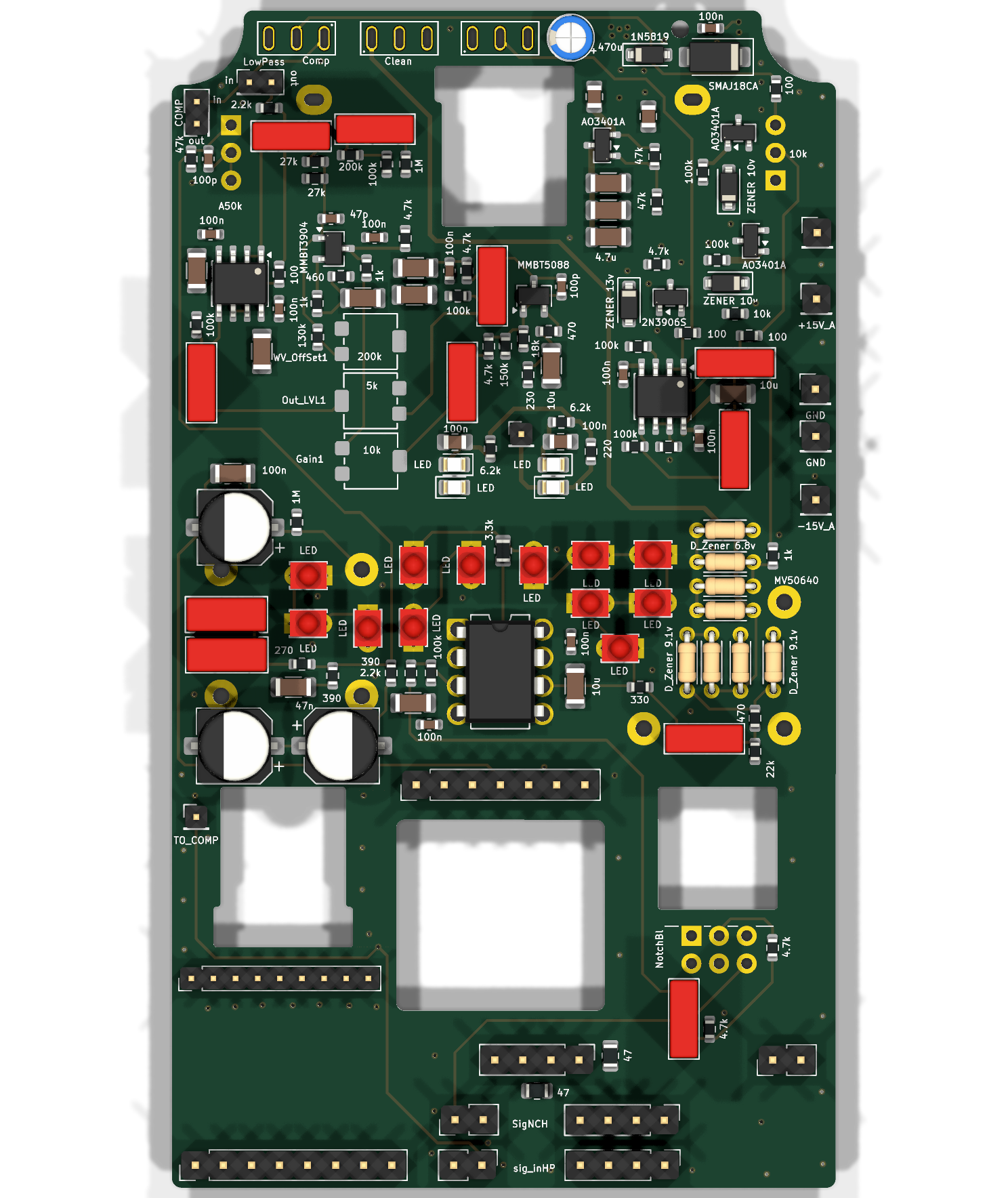
The 60.0 × 106.4 mm board carries the drive amplifier, twelve-LED ring, hard-clip ladder, CRz fuzz and the panel connections.
Signal path
Input → Wall of Ice → Twin Assassins / Notch Blend → Drive and LED ring → optional hard-clip ladder → optional CRz fuzz → Aurora Curtain → optional compressor and gate → Volume → output.
1. What this section does
This is the heart of the pedal: the stage that turns a clean signal into a distorted one, and the two additional clipping circuits that sit alongside it. Three tiers live here, each reachable from the panel: a high-gain amplifier that clips softly into a ring of red LEDs (always in circuit), a zener ladder that clamps hard (the Clean switch), and a two-transistor fuzz (the CRz switch). They can be used alone or stacked, and they are arranged so that each one takes a portion of the waveform the one before it left.
The drive keeps bass fundamentals available while three R–C voicing legs balance bass, mids and treble at the LED ring. Wall of Ice and Twin Assassins shape the signal before clipping; Aurora Curtain shapes its upper harmonics afterward.
2. The drive amplifier
The op-amp gain stage uses three R–C voicing legs. The Dist control provides up to 23 kΩ effective feedback, with R54 = 220 kΩ shunting the pot. The reference sweep uses 12.2 kΩ feedback, about half travel.
| Leg | Series R | Series C | Corner | Role |
|---|---|---|---|---|
| Bass | 150 Ω | 94 µF (C3 + C11, 2 × 47 µF) | 11 Hz | Full gain down to the bass guitar’s range |
| Mid | 390 Ω | 680 nF (C25) | 600 Hz | Body of the note; fills the 500 Hz–1 kHz shoulder |
| Treble | 1 kΩ | 39 nF | 4 kHz | Pick attack and presence |
At that setting, the supplied small-signal sweep rises from about +38.6 dB at 200 Hz to +43.6 dB at 20 kHz: a 5 dB spread. Bass, mids and treble now reach the LED ring at similar pick levels. With a playing-level 200 mV input, the whole band reaches the ring ceiling together rather than the treble arriving first.
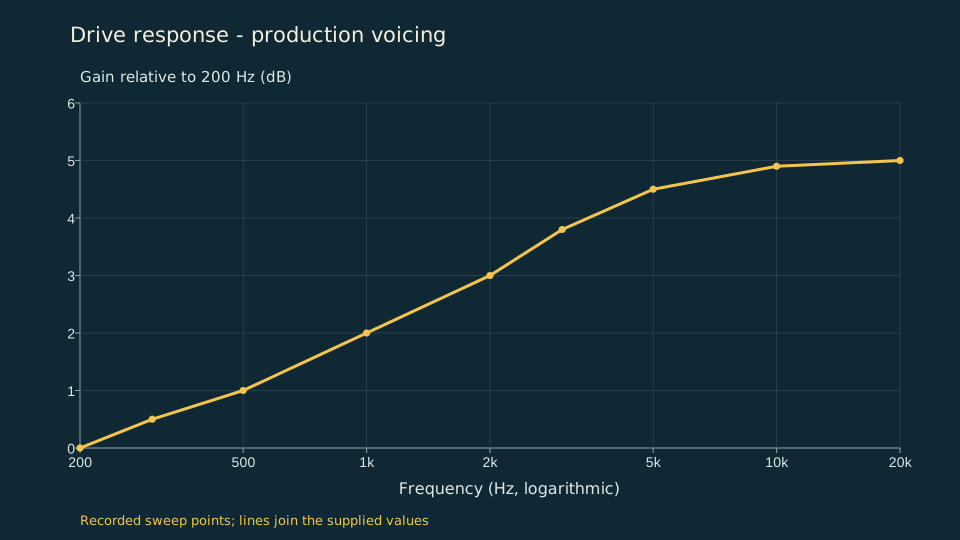
Read the chart data
| Frequency (Hz) | Relative gain (dB) | Absolute gain, approx. (dB) |
|---|---|---|
| 200 | 0 | 38.6 |
| 300 | 0.5 | 39.1 |
| 500 | 1 | 39.6 |
| 1000 | 2 | 40.6 |
| 2000 | 3 | 41.6 |
| 3000 | 3.8 | 42.4 |
| 5000 | 4.5 | 43.1 |
| 10000 | 4.9 | 43.5 |
| 20000 | 5 | 43.6 |
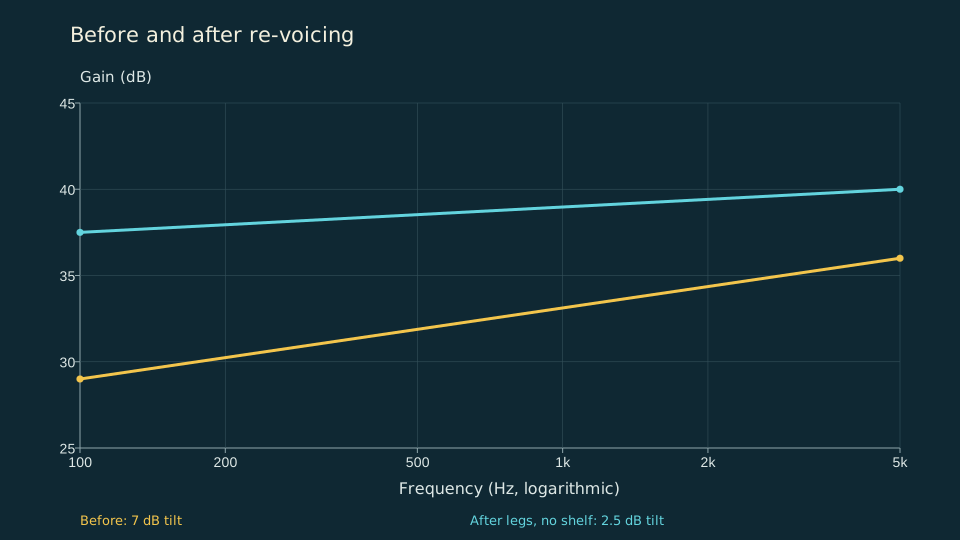
Read the chart data
| Frequency (Hz) | Before (dB) | After legs, no shelf (dB) |
|---|---|---|
| 100 | 29 | 37.5 |
| 5000 | 36 | 40 |
Presence shelf and Aurora Curtain
U3A adds a presence shelf with Rf = 5.6 kΩ and Rg = 10 kΩ in series with 3.9 nF to ground. The reported shelf is about +4 dB above 3 kHz, with its half-way point around 3 kHz and a flat region below 1 kHz.
The 200 kΩ Aurora Curtain control closes to a corner around 3 kHz, matched to that shelf. Open and closed responses lie together below 1 kHz. Closed, the response stays broadly flat within about 1 dB from 200 Hz to 3 kHz, then rolls off; open, it adds presence. The control therefore moves from a flat balance toward +4 dB presence, with useful travel across its range. A numerical closed-Curtain sweep was not supplied, so this comparison is described in words.
3. Tier 1: the LED ring
Two opposing strings of six red LEDs share R53 = 470 Ω in the nonlinear feedback path. As they conduct, they add feedback and progressively round the peaks. The soft knee is around 9 V and the ceiling around 12 V.
Ring onset depends on playing level: about 50 % Dist with a hot pickup, and about 80–95 % with a light touch. These are observed ranges, not a fixed knob threshold. Rail grind on the ±15 V supply begins above about 1.5 V peak at the input jack.
The LED network remains connected when the Clean switch bypasses the ladder. With low enough signal and Dist, it conducts little; increasing level moves progressively into rounding.
4. Tier 2: the zener ladder
Production specification: Two-step zener ladder: soft shoulder from ±3.65 V, flat at ±4.55 V.
| Rung | Positive branch | Negative branch |
|---|---|---|
| Hard clamp · no series resistor | D21 3.9 V zener + D27 1N914; flat near +4.55 V | D29 3.9 V zener + D28 1N914; flat near −4.55 V |
| Soft shoulder · R60 = 270 Ω | D10 3.0 V zener + D9 1N914; shoulder near +3.65 V | D2 3.0 V zener + D1 1N914; shoulder near −3.65 V |
The production D2 zener has its cathode toward D1. These are the production values specified in the November 1 update. Re-match Volume when changing clipping combinations.
The Clean switch engages or bypasses this ladder after the LED-feedback drive. CRz independently adds the transistor fuzz. Each stage reshapes the waveform arriving from the previous stage.
5. Tier 3: the CRz fuzz
CRz uses MMBT3904 and MMBT5088 transistor stages, with Asymmetry, Fuzz Gain and Fuzz Level trimmers behind the front panel. Its own low cut near 100 Hz gives it a different bass balance from the ring and ladder. Overload recovery with fuzz engaged is about 50 ms; this is a fuzz-stage result, not a settling-time specification for the whole pedal.
6. Coupling and output
Every coupling corner on the main board is below 2 Hz. C30 with R58 = 1 MΩ gives a reported corner of 0.72 Hz. After clipping, the signal passes through Aurora Curtain, then the optional compressor and gate, and reaches Volume and the output buffer.
Presence shelf and Aurora Curtain
U3A adds a presence shelf with Rf = 5.6 kΩ and Rg = 10 kΩ in series with 3.9 nF to ground. The reported shelf is about +4 dB above 3 kHz, with its half-way point around 3 kHz and a flat region below 1 kHz.
The 200 kΩ Aurora Curtain control closes to a corner around 3 kHz, matched to that shelf. Open and closed responses lie together below 1 kHz. Closed, the response stays broadly flat within about 1 dB from 200 Hz to 3 kHz, then rolls off; open, it adds presence. The control therefore moves from a flat balance toward +4 dB presence, with useful travel across its range. A numerical closed-Curtain sweep was not supplied, so this comparison is described in words.
7. Production specifications
| Item | Production value or supplied bench result |
|---|---|
| Supply | ±15 V from the Ćuk-Linear Dual Reactor |
| Drive feedback | Dist maximum 23 kΩ effective; R54 220 kΩ; reference sweep 12.2 kΩ |
| Voicing | 150 Ω / 94 µF bass; 390 Ω / 680 nF mid; 1 kΩ / 39 nF treble |
| LED ring | Six red LEDs per polarity; R53 470 Ω; knee around 9 V, ceiling around 12 V |
| Zener ladder | Soft shoulder ±3.65 V; flat clamp ±4.55 V; R60 270 Ω |
| Presence shelf | U3A: 5.6 kΩ feedback; 10 kΩ + 3.9 nF to ground; about +4 dB above 3 kHz |
| Coupling | All main-board coupling corners below 2 Hz; C30 / R58 1 MΩ: 0.72 Hz |
| CRz overload recovery | About 50 ms, fuzz stage only |
| Board | 60.0 × 106.4 mm |
8. Production service checks
- Use secure locking connectors for the ±15 V rail leads and confirm both rails before calibration.
- For the drive response reference, use 20 mV drive, Dist at 12.2 kΩ, filters open and a 10× output probe. Probe correction is already included in the published chart data.
- Check the three voicing legs, R54 = 220 kΩ, R53 = 470 Ω and the production ladder values against the tables above.
- Match output level after changing clipping or dynamics settings.
9. Production update
The November production update changes R5 to 150 Ω, C3 and C11 to 47 µF each, C25 to 680 nF, R54 to 220 kΩ and R58 to 1 MΩ. It specifies the U3A presence shelf and replaces the earlier response plots with the supplied production data.
The earlier Revision C document is retained as a source record, rather than as the current parts or calibration specification.
10. Working with the complete chain
Input → Wall of Ice (+6 dB, with the gate key taken after it) → Twin Assassins / Notch Blend → drive and LED ring → optional ladder → optional CRz fuzz → Aurora Curtain → optional compressor and gate → Volume → output.
Earlier source documents
The original Word references below predate the November production update. Their component values, charts and feedback presets are historical; use this page and the current compressor setup for production values.